
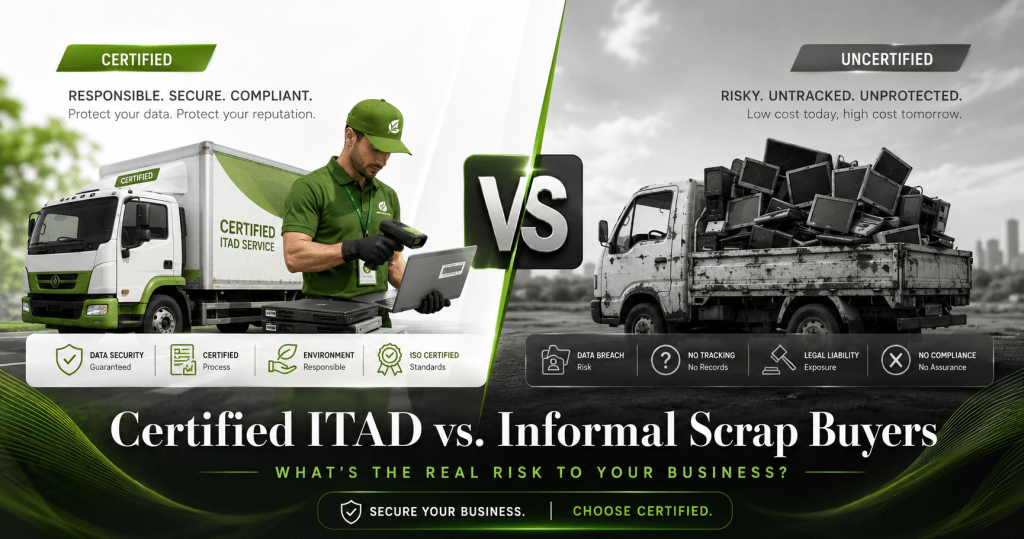
Every business in Dubai has had the same call: someone offers to clear out your old laptops, servers, and networking gear for free sometimes they’ll even pay you cash on the spot. No paperwork, no waiting, no certificates. Just a van, a few guys with screwdrivers, and an empty storeroom by the end of the day. It feels like a win. It almost never is.
The UAE’s IT asset disposal market has two very different tiers operating side by side: certified ITAD (IT Asset Disposition) companies working under ISO-accredited processes, and informal scrap buyers working with none. Both will take your old equipment off your hands. Only one of them can tell you, in writing, what actually happened to it afterward.
Here’s how the two compare and why the difference matters far more than most UAE businesses realise until something goes wrong.
The Quick Comparison
| What you need | Certified ITAD (e.g. Redolent) | Informal Scrap Buyer |
|---|---|---|
| ISO 9001 / 14001 / 45001 certification | Yes — verifiable, with expiry date | No, or unverifiable claims |
| Certificate of Data Destruction | Issued per batch or per device | Not provided |
| Data destruction standard | Aligned to NIST SP 800-88 | Unknown or none — drives often resold as-is |
| Chain-of-custody tracking | Serial numbers logged at pickup | Equipment loaded and gone — no log |
| UAE Federal Law No. 12/2018 compliance | Built into the process | Your liability, not theirs |
| PDPL accountability if data leaks later | Documentation protects you | You have no paper trail to point to |
| Hazardous material handling | Isolated and treated separately | Often dismantled by hand, materials discarded |
| Cost | May involve a fee, or resale value offsets it | Often “free” or cash-paying upfront |
That last row is the one that gets businesses every time. The informal buyer looks cheaper sometimes they even pay you — right up until the moment that “savings” turns into a six-figure liability.
1. “Free Pickup” Almost Always Means Resale, Not Recycling
When an unlicensed scrap buyer offers free collection or instant cash for your old IT equipment, they are not in the recycling business — they’re in the resale business. Working laptops and servers get resold, often with the original drives still inside. Non-working units get stripped for metal value, and whatever’s left plastics, mercury-containing components, flame-retardant casings gets discarded however is cheapest, not however is compliant.
This isn’t a hypothetical. It’s the default outcome whenever equipment passes through hands with no certification to lose and no audit to answer to.
2. The Real Risk Isn’t Environmental It’s Sitting on Your Hard Drives
This is the gap that should worry any UAE business owner or IT manager more than the sustainability angle. A retired laptop or server is not just hardware it’s financial records, client data, credentials, and proprietary files, all still physically present on the drive even after a factory reset or a quick “delete.”
Informal buyers have no reason to wipe anything properly, because a working drive with data intact is worth more to resell than a securely erased one. That laptop you handed over “for free” can end up resold in a second-hand market with your company’s data still recoverable on it and there is no certificate, no log, and no recourse if that happens.
Under the UAE’s Personal Data Protection Law (PDPL), your business remains accountable for how that data was handled, right through to disposal. A breach traced back to equipment you handed to an uncertified scrap buyer is treated as a compliance failure on your end not theirs, since there’s no contract or certification tying them to the outcome in the first place.
3. Zero Paper Trail Means Zero Protection in an Audit
If your business is ever asked to prove how retired IT assets were disposed of during a PDPL inquiry, an insurance claim, an ISO audit, or simply a client due-diligence request “we gave it to a scrap collector who came by the office” is not an answer that holds up.
A certified ITAD provider gives you:
- Serial numbers logged at the point of collection
- A documented chain of custody from pickup to final disposition
- A Certificate of Data Destruction naming the method used, per device or per batch
- ISO 9001, 14001, and 45001 certificates you can verify directly with the issuing body
An informal buyer gives you an empty storeroom and a memory of a van driving away.
4. Compliance Risk Under UAE Law Falls on You, Not the Scrap Buyer
Federal Law No. 12 of 2018 on Integrated Waste Management sets out how hazardous waste a category that includes most categories of e-waste must be segregated, treated, and disposed of under the supervision of the competent authority. Handing equipment to an unlicensed operator doesn’t transfer that compliance obligation away from your business; it just removes your visibility into whether it’s being met at all.
Individual emirates layer additional municipal requirements on top of this, and improper disposal of waste more broadly carries real financial penalties under UAE regulations. A certified recycler builds compliance into the process by default. An informal buyer leaves you exposed and unable to prove otherwise.
5. Hazardous Materials Don’t Disappear Just Because They’re Out of Your Office
Batteries, UPS units, and the lead and mercury-bearing components inside monitors and circuit boards need to be isolated and treated separately from general material recovery. This is standard procedure at a certified facility. It is rarely standard procedure for a scrap dealer working out of an open yard, where the priority is extracting copper and aluminium fast not handling what’s left over safely.
What looks like a tidy, completed job from your office window can mean improperly handled hazardous waste somewhere downstream, with your business as the documented last point of custody before it disappeared from view.
6. “It’s Cheaper” Is Often an Illusion
On paper, free collection or cash-on-pickup looks like the better deal next to a recycler that may charge a collection fee. In practice, certified ITAD providers frequently offset or eliminate that fee through resale value recovery on equipment that still has working life left value that’s assessed transparently, not estimated by whoever’s loading the van.
And that’s before weighing the cost of what happens if a single device resurfaces with company data still on it. There is no “savings” large enough on the front end to offset a data breach, a PDPL finding, or a client relationship damaged by a disclosure you can’t fully explain.
How to Tell the Difference Before You Hand Over a Single Device
Ask any IT disposal provider these questions before they touch your equipment:
- Can you provide current ISO 9001, 14001, and 45001 certificates, and who issued them?
- What data destruction standard do you follow, and is it aligned with NIST SP 800-88?
- Will you log serial numbers at collection and provide a Certificate of Data Destruction?
- Can you describe your chain of custody from pickup to final disposition?
- How do you handle batteries and hazardous components separately from general recovery?
A certified provider will answer all five without hesitation. An informal buyer will usually answer none of them and that gap is the entire risk, in one conversation.
Where Redolent Fits
Redolent Group operates under ISO 9001:2015, ISO 14001:2015, and ISO 45001:2018 certification issued via IMCD Certification, valid through September 2028, with data destruction aligned to NIST SP 800-88. Every collection comes with serial-number-level logging and a Certificate of Data Destruction, so your business has documentation on file not a memory of a van leaving the office if anyone ever asks how your old IT equipment was handled.
If you’re currently using whoever happens to call first or show up with a truck, it’s worth a five-minute comparison before your next office refresh. Free collection that creates an unverifiable gap in your data trail is rarely free in the end.
Frequently Asked Questions
Is it illegal to sell IT equipment to an uncertified scrap buyer in the UAE?
It isn’t automatically illegal to sell working equipment, but your business remains responsible for how any data-bearing devices were handled under the UAE’s data protection law, and for ensuring hazardous waste categories are managed in line with Federal Law No. 12 of 2018. Using an uncertified buyer doesn’t remove that responsibility it just removes your ability to prove you met it.
How do I verify if an e-waste recycler’s ISO certification is real?
Ask for the certificate number and the name of the accredited issuing body, then contact that body directly to confirm the certificate is current and was actually issued to that company. A reputable recycler will provide this without pushback.
What’s the actual difference between “recycling” and “resale” when a scrap buyer takes my equipment?
Recycling means equipment is dismantled, materials are recovered, and any data-bearing components are securely destroyed first. Resale means the device and whatever is still on its drive is sold on as-is to a new owner. Many informal buyers default to resale because it’s more profitable, regardless of what the equipment is being disposed of for.
Can a Certificate of Data Destruction protect my business in a PDPL audit?
Yes. It serves as documented evidence that data-bearing assets were handled and destroyed through a defined, traceable process, which is what regulators and auditors look for when assessing whether a business met its data lifecycle obligations.
Does using a certified ITAD provider cost more than an informal scrap buyer?
Not necessarily. Certified providers often recover resale value from equipment that still has working life left, which can offset or eliminate collection costs. The price difference, where it exists, reflects the cost of documentation, certified data destruction, and compliant handling not markup.